
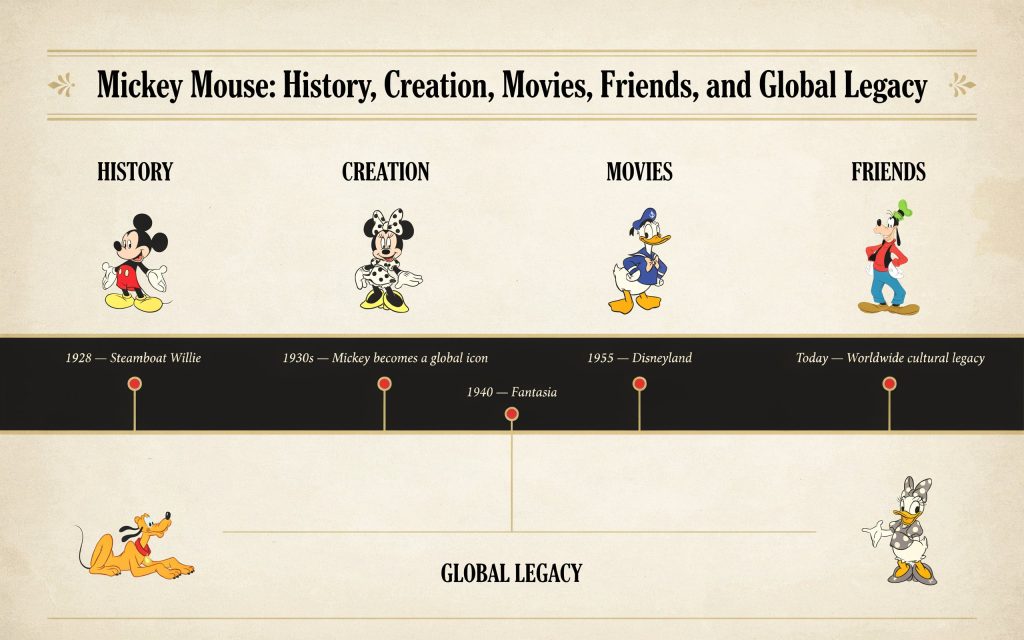
Mickey Mouse: History, Creation, Movies, Friends, and Global Legacy
1. Introduction
Mickey Mouse is one of the most recognizable cartoon characters in the history of entertainment. With his round ears, cheerful smile, white gloves, and friendly personality, he has entertained millions of children and adults around the world. From classic black-and-white cartoons to modern animated shows, movies, video games, and theme parks, his popularity has continued for generations.
But how did this famous cartoon character become a worldwide entertainment icon? Who created him, what was his first appearance, and why do people still love him today?
His story is not just about cartoons. It is also about creativity, imagination, friendship, and the development of modern animation.
2. Who Is Mickey Mouse?
Mickey Mouse is a fictional cartoon character created by Walt Disney and Ub Iwerks. He first appeared publicly in the animated short film Steamboat Willie, which premiered on November 18, 1928.
He was introduced as a playful and energetic mouse who enjoyed adventures and entertaining people. His friendly personality, humorous behavior, and recognizable appearance quickly helped him become popular.
Over the years, he has appeared in hundreds of animated productions, television programs, video games, books, and other entertainment projects.
His Physical Appearance
His appearance is one of the biggest reasons behind his recognition. Some of his most familiar features include:
- Two large, round black ears.
- A circular face and cheerful smile.
- A small black nose.
- White gloves.
- Red shorts with two white buttons in his classic design.
- Large yellow shoes in many modern appearances.
These simple features make him easy to recognize, even when artists present him in different animation styles.
His Personality
Mickey is generally portrayed as friendly, optimistic, curious, and adventurous. He enjoys spending time with his friends and often tries to help others when they experience difficulties.
Although he sometimes makes mistakes, he usually finds ways to solve problems through patience, courage, and teamwork.
His personality makes him appealing to children while also giving adults a familiar and enjoyable character to remember.
3. The Creation of Mickey Mouse
The story of Mickey Mouse began during an important period in the history of American animation.
Before creating this character, Walt Disney worked on another cartoon character called Oswald the Lucky Rabbit. Disney and his animation team produced several cartoons featuring Oswald. However, a business disagreement over ownership and creative rights resulted in Disney losing control of the character.
This experience encouraged Disney to develop a completely new character that could become the foundation of his animation business.
Walt Disney’s Original Idea
After losing Oswald, Disney needed a fresh idea. He began exploring different character designs and eventually developed the concept of a friendly cartoon mouse.
According to a popular historical account, Disney’s earlier experience with a pet mouse helped inspire the idea. However, the creation of the final character involved considerable teamwork and artistic development.
Ub Iwerks’ Contribution
Ub Iwerks played an important role in designing and bringing the original character to life. He was an exceptionally talented animator who helped establish Mickey’s appearance and animated many early sequences.
Walt Disney contributed the creative direction, personality, and storytelling vision.
Their collaboration demonstrates how successful entertainment projects often depend on different creative skills working together.
The First Animated Productions
The first Mickey Mouse cartoon produced was Plane Crazy, followed by The Gallopin’ Gaucho. However, these early productions did not immediately achieve the commercial success Disney wanted.
The breakthrough came with Steamboat Willie, which introduced synchronized sound and helped make the character famous.
4. Steamboat Willie: The Cartoon That Made History
Steamboat Willie premiered on November 18, 1928, and became one of the most important animated short films in entertainment history.
During this period, silent cartoons were still common. Although filmmakers had experimented with sound, combining music, dialogue, and animated movements in a synchronized way was an important development.
The film helped demonstrate how sound could make animated characters more entertaining and expressive.
The Story of the Film
The short cartoon features Mickey working aboard a riverboat. He interacts with the environment, creates musical moments, and becomes involved in humorous situations.
The storyline is relatively simple, but its sound effects, music, and physical comedy made it memorable.
Why Was It Important?
The success of Steamboat Willie helped establish synchronized sound as an important feature of animated filmmaking.
It also introduced audiences to a character who could entertain through expressions, movements, and music.
November 18 is celebrated as Mickey Mouse’s official birthday because it marks the public premiere of this famous production.
The film became a turning point for Walt Disney’s animation studio and helped establish a foundation for future animated entertainment.
5. How Mickey Mouse’s Appearance Changed Over Time
Mickey’s appearance has changed considerably since his earliest animated appearances. However, the basic design has remained recognizable throughout his history.
In the beginning, animation technology was limited, so artists used simple shapes and movements to create characters.
As animation techniques improved, Mickey’s design became more detailed, colorful, and expressive.
The Original Black-and-White Design
The earliest version featured a simple circular head, large ears, thin arms, and a long tail.
His original appearance was designed to make animation easier and allow artists to create smooth movements.
The black-and-white design became an important part of early Disney animation history.
The Introduction of Color
During the 1930s, color animation became increasingly popular. Mickey eventually appeared in colorful productions, and his familiar red shorts, yellow shoes, and white gloves became important parts of his identity.
These colors helped make the character more visually appealing and recognizable.
The Modern Design
Modern versions feature smoother movements, more expressive facial details, and updated proportions.
Different productions sometimes use slightly different artistic styles, but the character’s essential appearance remains familiar.
His development is similar to the modernization of a classic building. New materials and techniques may improve its appearance, but the original design remains recognizable.
6. Famous Mickey Mouse Movies and Television Shows
Throughout his career, Mickey has appeared in numerous animated productions. These films and television programs have introduced him to different generations of audiences.
Some productions became particularly important because they demonstrated how animated characters could entertain viewers through creative storytelling.
Fantasia (1940)
One of Mickey’s most memorable appearances came in Disney’s animated feature Fantasia.
In the famous segment The Sorcerer’s Apprentice, Mickey plays an apprentice who uses magic without fully understanding its consequences.
He puts on his master’s enchanted hat and gives a broom the ability to carry water. However, the situation quickly becomes difficult to control.
The sequence combines classical music, fantasy, and visual storytelling. It remains one of the most recognizable moments in Disney animation history.
The Mickey Mouse Club
The original The Mickey Mouse Club television program premiered in 1955.
The show introduced a group of young performers known as Mouseketeers and became an important part of American television entertainment.
Although Mickey was not the central live-action performer, his character served as a major symbol of the program.
Mickey Mouse Clubhouse
Mickey Mouse Clubhouse introduced the character to a younger audience.
The animated series focused on simple adventures, problem-solving, numbers, shapes, and teamwork.
It encouraged children to participate in the stories and think about solutions to everyday challenges.
Modern Animated Productions
Disney continued creating new animated adventures, including the 2013 Mickey Mouse television series and The Wonderful World of Mickey Mouse.
These productions introduced different animation styles and storytelling techniques while maintaining the character’s familiar personality.
7. Mickey Mouse’s Friends and Supporting Characters
Mickey’s friends are an important part of his fictional world. Their different personalities create entertaining situations and make the stories more interesting.
Together, these characters represent friendship, loyalty, humor, and cooperation.
Minnie Mouse
Minnie Mouse is Mickey’s longtime friend and romantic partner. She first appeared alongside him in Steamboat Willie in 1928.
Minnie is generally portrayed as kind, confident, caring, and fashionable.
She enjoys music, social activities, and spending time with her friends. Her relationship with Mickey is an important part of many Disney stories.
Donald Duck
Donald Duck is one of Mickey’s closest friends.
Unlike Mickey’s generally calm personality, Donald is famous for his short temper, humorous reactions, and occasional bad luck.
His unpredictable behavior creates funny situations and makes his adventures entertaining.
Goofy
Goofy is another important character in Mickey’s group of friends.
He is friendly, cheerful, and sometimes clumsy. His unusual way of thinking often creates unexpected problems, but his good intentions make him lovable.
Pluto
Pluto is Mickey’s loyal pet dog.
Unlike several other Disney characters, Pluto generally communicates through barking, facial expressions, and physical movements rather than speaking like a human.
He brings warmth and humor to the stories and represents the special bond between people and their pets.
Why These Friendships Matter
Each supporting character contributes something different to the stories.
Minnie brings warmth, Donald brings comedy, Goofy brings unpredictable humor, and Pluto represents loyalty.
Their relationships help create an entertaining fictional world that audiences can enjoy across different generations.
8. Mickey Mouse’s Personality and Life Lessons
One reason Mickey has remained popular is his personality. He represents positive qualities that children and adults can understand.
He is not always perfect. Sometimes he makes mistakes, becomes confused, or finds himself in difficult situations. However, he usually tries to make things better.
Friendship and Loyalty
Friendship is one of the strongest themes in his stories.
He regularly supports his friends and tries to help them when they experience difficulties.
His relationships with Minnie, Donald, Goofy, and other characters demonstrate the importance of respecting people with different personalities.
Optimism During Difficult Situations
Mickey is usually optimistic, even when things do not go according to plan.
His attitude suggests that problems are not necessarily the end of an adventure. Sometimes, a difficult situation becomes an opportunity to learn something new.
Courage and Curiosity
Many stories place him in unfamiliar environments or challenging situations.
Instead of avoiding every problem, he often explores his surroundings and searches for solutions.
This encourages young viewers to remain curious and approach challenges with confidence.
Learning From Mistakes
Another valuable lesson is that making mistakes is a normal part of life.
His stories frequently show that poor decisions can create problems, but patience, honesty, and teamwork can help resolve them.
These themes make his cartoons enjoyable for children while giving adults something positive to appreciate.
9. Mickey Mouse’s Global Popularity and Cultural Influence
Mickey’s popularity eventually extended far beyond American television and cinema.
Today, he is recognized in many countries, languages, and cultures. His image appears on clothing, toys, books, school supplies, accessories, and countless other products.
His international success is connected to entertaining storytelling, recognizable design, and decades of creative development.
An International Entertainment Symbol
Disney productions have been distributed internationally for generations.
Through cinemas, television broadcasts, home video, streaming platforms, and digital media, audiences have had many opportunities to discover his adventures.
His stories also rely heavily on physical comedy, facial expressions, and gestures, making much of the humor understandable without extensive dialogue.
Influence on Animation
His success helped establish animated characters as major entertainment personalities.
Early Disney productions demonstrated that cartoons could become recognizable brands with continuing stories, memorable supporting characters, and long-lasting audience relationships.
Many later animated productions adopted similar approaches.
Influence on Popular Culture
Mickey has become a familiar part of everyday culture.
His image appears in fashion collections, advertisements, collectibles, children’s products, and entertainment events.
His famous ears and red shorts can often be recognized without showing his complete face.
He is no longer simply a cartoon character. He is an important symbol of animation history and family entertainment.
10. Disney Theme Parks, Merchandise, and Business Success
Mickey’s influence is not limited to animated productions. He also plays an important role in Disney theme parks and merchandise.
For millions of visitors, meeting Mickey is one of the most memorable experiences of visiting a Disney destination.
Appearances in Disney Theme Parks
Mickey is a major character at Disneyland Resort in California and Walt Disney World Resort in Florida, as well as Disney parks in other countries.
Visitors can see him in themed attractions, parades, stage performances, photographs, and character meet-and-greet experiences.
These activities allow audiences to interact with a character they may have known through cartoons since childhood.
Toys and Collectibles
Mickey-themed merchandise includes:
- Soft toys and stuffed animals.
- Clothing and fashion accessories.
- Watches and home decorations.
- School bags and stationery.
- Collectible figures and limited-edition items.
- Books, puzzles, and board games.
Vintage merchandise has also become interesting to collectors because of its connection to early Disney history.
A Recognizable Business Identity
Mickey has become one of Disney’s most recognizable entertainment symbols.
His consistent visual identity makes him suitable for different products and audiences.
A child might recognize him through a toy, while an adult might associate him with childhood memories or classic animated films.
This ability to connect with different generations has helped maintain his commercial importance.
11. Mickey Mouse and the Public Domain: What Changed in 2024?
One of the most interesting developments in Mickey’s modern history occurred on January 1, 2024.
The original version of Mickey Mouse featured in Steamboat Willie entered the public domain in the United States after the copyright protection for that specific work expired.
This was an important event for filmmakers, artists, researchers, and the entertainment industry.
What Does Public Domain Mean?
Public domain refers to creative works that are no longer protected by copyright restrictions in a particular country.
In the United States, people can generally use public-domain material without obtaining permission from the original copyright holder, subject to other applicable laws.
For example, the original 1928 version of Mickey can be used in new creative projects.
Can Anyone Use Every Mickey Mouse Design?
No. The public-domain status applies to the specific early version that appeared in Steamboat Willie.
It does not automatically apply to later designs, films, or other protected creative material.
Modern versions have separate copyright considerations.
Trademark protection is another important issue. Disney continues to have trademark rights that may apply to the character’s name, branding, and commercial identity.
Why Does This Matter?
The change created new opportunities for independent creators to explore the original character in their own projects.
It also demonstrated how copyright laws influence entertainment and creative industries.
Anyone planning to use the character commercially should carefully distinguish between public-domain material, protected later versions, and trademark restrictions. The legal position can also differ outside the United States.
12. Interesting Facts About Mickey Mouse You Might Not Know
Behind the familiar smile and famous ears are many interesting details about his history.
Here are some facts worth knowing.
- His Original Name Was Almost Different
During the development process, Walt Disney considered the name Mortimer Mouse. However, his wife, Lillian Disney, reportedly suggested Mickey instead.
- His Official Birthday Is November 18
November 18, 1928, is considered his official birthday because it was the premiere date of Steamboat Willie.
- He Was Originally a Black-and-White Character
His earliest cartoons were produced in black and white. Color was introduced into his animated appearances later.
- Walt Disney Provided His Original Voice
Walt Disney personally voiced Mickey during the early years. His voice helped establish the character’s friendly and energetic personality.
- He Appeared in Fantasia
His role in Fantasia as the Sorcerer’s Apprentice became one of the most memorable moments in Disney animation history.
- He Received a Star on the Hollywood Walk of Fame
Mickey received his star on November 18, 1978, becoming the first fictional character to receive this recognition.
- He Has Appeared in Different Artistic Styles
From traditional hand-drawn animation to computer-generated productions, Mickey has been recreated using many different animation techniques.
- His Famous Ears Are an Important Design Feature
The round ears are among his most recognizable visual characteristics. Artists have often maintained their familiar appearance even when drawing him from different angles.
- He Became an International Character
His cartoons have been distributed across the world, making him familiar to audiences who speak different languages.
- His Popularity Has Lasted for Generations
Parents who watched his early cartoons can now introduce newer versions of the character to their children and grandchildren.
These facts show how a relatively simple animation idea developed into an international entertainment phenomenon.
13. Why Mickey Mouse Remains Popular With New Generations
Many fictional characters become famous for a few years and then disappear from public attention. Mickey’s story has been different.
His continued popularity is the result of several factors working together.
A Simple and Memorable Design
His appearance is easy to recognize.
Even a basic drawing of two round ears and a circular face can remind people of the character.
This simplicity is a major advantage because his design works across different formats, from small toys to large theme park displays.
Stories That Appeal to Different Ages
Children enjoy the colorful adventures, funny situations, and friendly characters.
Adults may appreciate the nostalgia, animation history, and memories associated with watching Disney cartoons.
This combination allows the character to remain relevant across generations.
Continuous Creative Development
Disney has introduced new productions, updated designs, and different storytelling styles over the years.
Rather than depending entirely on older cartoons, the company has continued adapting the character to changing entertainment preferences.
A Connection With Childhood Memories
For many people, watching Mickey cartoons is connected to family time, school holidays, and childhood entertainment.
These emotional connections can remain meaningful even when people grow older.
A Positive and Welcoming Personality
His friendly attitude and willingness to help others make him a character that parents can comfortably introduce to young children.
He represents an enjoyable form of entertainment that does not depend on complicated storylines or difficult concepts.
In many ways, his success is like a familiar song. The presentation may change with time, but the basic feeling it creates remains recognizable.
14. The Future of Mickey Mouse in Modern Entertainment
The entertainment industry continues to change through streaming platforms, digital animation, video games, and interactive experiences.
These developments create new opportunities for classic characters to reach audiences in different ways.
Mickey is well positioned to remain part of this changing environment because his identity is already familiar to millions of people.
Digital Animation and Modern Storytelling
Computer-generated animation allows filmmakers to create detailed environments, realistic movements, and visually impressive scenes.
At the same time, traditional animation techniques remain important because they provide a distinctive artistic style.
Future productions can combine these approaches to introduce fresh adventures without losing the character’s original charm.
Streaming Platforms
Streaming services have changed how families watch entertainment.
Instead of waiting for scheduled television programs, viewers can choose cartoons and films whenever they want.
Disney’s streaming platform, Disney+, provides another way for audiences to explore its entertainment library.
Video Games and Interactive Entertainment
Interactive experiences allow audiences to become more involved in fictional worlds.
Mickey has appeared in various video games, including platform adventures and other family-friendly gaming experiences.
Games such as Disney Illusion Island demonstrate how familiar characters can be introduced through modern interactive storytelling.
A Lasting Entertainment Legacy
The future of the character will depend on how successfully new productions balance innovation with the qualities that made him popular in the first place.
His friendly personality, recognizable appearance, and connection to animation history provide a strong foundation for future storytelling.
As long as audiences continue enjoying imaginative animated entertainment, there will be opportunities for new generations to discover his adventures.
15. Conclusion
Mickey Mouse is much more than a famous cartoon character. His journey from early black-and-white animation to international entertainment represents one of the most important developments in animation history.
Created through the creative partnership of Walt Disney and Ub Iwerks, he became a symbol of imagination, friendship, and family entertainment.
His memorable appearance, positive personality, classic films, and relationships with other Disney characters have helped him remain popular for generations.
Although animation technology and audience preferences continue to change, his legacy remains an important part of global popular culture.
Frequently Asked Questions (FAQs)
- Who created Mickey Mouse?
Mickey Mouse was created by Walt Disney and Ub Iwerks. Disney helped develop the character and its personality, while Iwerks played a major role in designing and animating the original version.
- When did Mickey Mouse first appear?
He made his public debut in Steamboat Willie, which premiered on November 18, 1928. This date is also celebrated as his official birthday.
- What was Mickey Mouse’s original name?
Walt Disney initially considered naming the character Mortimer Mouse. However, Lillian Disney reportedly suggested Mickey Mouse, and that name was eventually chosen.
- Who was the original voice of Mickey Mouse?
Walt Disney provided the character’s original voice. He voiced Mickey for many years before other performers took over the role.
- Is Mickey Mouse in the public domain?
The original 1928 version featured in Steamboat Willie entered the public domain in the United States on January 1, 2024. However, later versions, protected creative material, and relevant trademarks remain subject to separate legal protections.